
April is Caesarean awareness month, so, I thought it was a good time to blog about all things caesarean! As I haven’t had a caesarean birth, I decided to reach out to a few friends to see what their experiences were like. These blogs are a mix of friends’ stories and factual research. I hope you find them informative!
The one thing I got from every story I received was that women who have caesarean births are strong! All of their stories left me feeling complete and utter admiration. Not only do these women go through major surgery, they then crack on with the all-consuming and labour-intensive task of motherhood the minute surgery is over (actually, before it’s over!)
I wanted to start by saying that because sadly, and frustratingly, all of the caesarean birth stories I gathered had this in common too: they all said that they felt the general public thought of caesarean birth as an ‘easy option’! Sorry, what? Not that it’s anyone’s business to judge how easy or difficult your birth was, but if it was, how has major surgery managed to get a reputation for being a soft option? I can’t fathom it! So, if you have had a caesarean birth, or are planning one, please know that I think you’re bloody amazing.
Now onto the blog…
When I started writing this I thought, what do pregnant people want to know about caesareans? Here’s what I remember I wanted to know when I was pregnant:
- How do I avoid an unnecessary caesarean?
- If I have an unplanned/emergency caesarean, what can I do to make it a positive birth experience?
- If decide I need or want one in advance, how do I plan for a positive ‘elective’ caesarean?
So, I’m going to answer these questions in a series of blogs!
As ever, if you’re interested in learning more about using hypnobirthing to plan for a positive birth, be it a vaginal birth or a caesarean, please check out my courses page and contact me with any questions!
Ok, I’ll get on and answer the question now… How do you avoid an unnecessary caesarean…
Wait, firstly, what do you consider to be ‘unnecessary’?
Caesareans are life-saving operations and I personally felt that it was much easier to let go of fear about child birth knowing that I was close to a hospital with an obstetrician who could perform one for me if I needed it. But I also remember feeling anxious that I might ‘end up’ with a caesarean that I didn’t need (which is exactly what nearly happened to me when I had my first baby). The World Heath Organisation say that if caesareans were only used in ‘life-saving’ circumstances that between 10-15% of births would be caesarean births (read in full here). So, what’s the actual caesarean rate? In 2022, 34% of births in the UK were caesareans (data here). You can see why some would say that a big chunk of the caesareans happening in the UK are therefore ‘unnecessary,’ because they weren’t needed to save a life. But that’s presuming caesareans for other reasons, such as because the women giving birth wants one, are ‘unnecessary’. Women have the right to choose a caesarean if they want one, even if they don’t ‘need’ one for medical reasons. But I don’t think that all of those ‘extra’ caesareans were given to people who really wanted one. I know from the stories I gathered that many women have caesareans that they didn’t want.
The question is, why do people who don’t want or need a caesarean have one? And if you’re pregnant, how can you avoid a caesarean that you don’t want or need?
Here are a few practical things you can be aware of to avoid an unnecessary caesarean.
1. Where you give birth matters
The birth place study from 2011 found that healthy women with low risk pregnancies were more likely to have an unplanned caesarean if they choose to have their baby in a hospital setting. (Note, this is based on where women planned to birth, not where they actually birthed).
| Planned place of birth | % of women who had an unplanned caesarean |
| Home | 2.8% |
| Free-standing Midwife Led Unit (birth centre) | 3.5% |
| Alongside Midwife Led Unit (birth centre in same building as a hospital) | 4.4% |
| Obstetric Unit (hospital/labour ward) | 11.1% |
Since 2011, caesarean rates have increased. In 2022, in the UK, 15% of all births were planned caesareans and 19% of all births were emergency caesareans (data here). I know that my local hospital has higher figures of unplanned caesareans than this. I looked at the unplanned caesarean rate at The Royal Oldham Hospital and found that between January 2023 – October 2023 the ’emergency’ caesarean rate was between 27% – 37%. Their planned caesarean rate was around the 13% – 18% mark(data here). That’s a lot of caesareans considering the World Health Organisation say between 10% – 15% of births should be via caesarean in order to improve outcomes for women and babies (any more and it’s likely that more harm than good is being done. That’s women who had planned a vaginal birth but for some reason, during labour, things changed and she had a caesarean. I do not think Oldham are alone in this – I would urge you to check your local hospital’s figures.
So why does choosing a home birth or birth centre birth help prevent a caesarean?
Midwives and obstetricians
Well, one theory is that at home, or at a birth centre, you’re being cared for by midwives. Midwives are experts in ‘normal’ birth, that is, birth that is going well and doesn’t need much, if any help. So, midwives are less inclined to try and ‘fix’ birth, as they know it usually doesn’t need fixing (they are also brilliant at spotting when it isn’t going well and does need help, just to reassure you!).
Whereas if you choose to birth in a hospital, you’ll be under the care of obstetricians (doctors). Obstetricians are highly qualified and skilled in helping women through birth when things deviate from ‘normal’. They are not usually called to a birth unless there is a complication, or an increased risk of a complication. They mostly see difficult births and some may have never actually seen a straight forward birth. How do you think this affects their perception of birth? Do you think it’s balanced, or skewed towards thinking birth is more dangerous than it is? Could some be over-keen to help, even when they aren’t needed? Or, is it the policies in place in hospitals that obstetricians have to follow that result in this pretty big difference in intervention rate? Maybe they’re worried about litigation, which is a serious and very real concern for most obstetricians and midwives. All seem to be plausible explanations for why the caesarean rate is so much higher for women who choose to birth in hospitals, where obstetricians are in charge. Just to be clear, I am not criticising obstetricians, who I respect and whose expertise I am grateful for. But the study is worth being aware of when you are choosing where you plan to give birth.
Birth Environment
Maybe it’s the birth environment itself that can increase or reduce the risk of caesarean? An environment where you feel safe and private can make a big difference to how birth progresses (and if it’s ‘progressing well’, as in, it isn’t taking ‘too long’, a caesarean is less likely to be offered). Women are more likely to be supported to follow their instincts and ‘do their own thing,’ at home or in a birth centre. By this I mean get into the positions they feel good in, breathe however they want to, move around however they like, eat, drink, stay relaxed and happy. Birth centres are more likely to have birth balls, birth pools, dimmed lighting, and many other things that help birth, and if you’ve planned a home birth, chances are you’ve put some thought into making it a great birth environment and have perhaps sourced your own birth pool. All of this is likely to speed up labour and reduce likelihood of a caesarean even being considered.
In a hospital ward, you’re more likely to have a bed in a brightly lit room with more people attending you. This doesn’t help you produce those vital birth hormones that help keep labour moving. Also, you’re more likely to go into ‘patient mode’ and do what you’re told, rather than what feels right, which again, will hinder the birth process and potentially lead to your body sub-consciously thinking, ‘don’t give birth here, it’s not safe!’. This could result in you being offered different ways to ‘speed labour up,’ and you could be offered a caesarean if labour doesn’t progress at the speed your care providers feel comfortable with. That’s not to say a hospital ward can’t be made into a lovely birth environment with some planning and effort on your part, but it’s just not likely to already be like that when you arrive. On my hypnobirthing courses, we look at how to create a great birth environment wherever you choose to birth! We also look at ways to get labour moving again if it’s stalled due to you feeling unsafe or under pressure. Most women feel stressed or anxious at some point during labour, so on my courses I’ll give you the tools you need to get back into a relaxed state and reassure your body that it’s safe to birth.
The ‘Cascade of Intervention’
Then there’s the idea that hospitals increase the risk of ‘the cascade of intervention.’ This is a phrase you may have heard of before. I don’t really like it (I picture a gushing waterfall- it seems more dramatic and fast than the experience it’s trying to describe, but whatever…) It means that one intervention (any external help, be it pain relief, an examination…anything from the caregivers basically) may come with ‘conditions’ or effects that you may not know about. It means that ‘one thing leads to another’. I think it’s best explained with a simple example from my own birth story of Penelope, (my first baby).
Intervention 1: I left the house to have a baby
Intervention 2: On arrival, I was examined and told I was 4cm dilated. This made me feel devastated. I didn’t have any idea what this really meant (nothing!) and wrongly interpreted it to mean I was only ‘40% of the way there!’ Cue ‘I can’t do this!’ melt down.
Intervention 3: Because I was now in a hospital setting, and very upset, I was offered diamorphine. This slowed my contractions down.
Intervention 4: Because the drugs had slowed things down, the obstetricians suggested continuous foetal monitoring, which I guess I accepted (no memory of the conversation!).
Intervention 5: Because of the monitoring, I had to stay relatively still. So, I lay on the bed (meaning gravity wasn’t on my baby’s side in terms of getting out!)
Intervention 6: Because I was being monitored, when I decided to get into a better position to birth to try and get things moving, I set off the sensor (the monitor momentarily lost Penelope’s heart rate) which sent the room of people into a flap and led to me signing, in a blind panic, a form to say I consented to a forceps delivery or a caesarean birth.
Intervention 7: Because I had signed the form, all attempts to keep going with birth seemed to stop! I was sat in a wheelchair (somewhat blocking the exit for Penelope!) and wheeled off to theatre.
Can you see how one thing led to another? I wonder constantly what would have happened if I’d not gone to hospital, or if I’d not had that vaginal exam (or even if I’d just not been told the result!)… I can’t play sliding doors and see, but I think things would have been very different (and much more straight forward) had I just made one of those early decisions differently.
That’s why it’s important that if or when you accept any form of intervention, from a paracetamol to an induction, you consider what the indirect consequences may be. You can ask your caregivers this. Things like ‘If I accept this, can I still get into the pool/move around/use my birth ball…’ etc will really help give you a clear idea of what exactly you’re signing up for! But to be honest, you don’t really want to be considering this for the first time whilst in labour. Doing a hypnobirthing course or a good amount of research into the benefits and risks of the most commonly offered interventions (vaginal exams, induction, monitoring, having waters broken, etc.) is a very good idea.
On my hypnobirthing course we talk though lots of the interventions you may be offered and discuss how to talk to your caregivers about the risks and benefits so that you can make fully informed decisions. (Read more about my courses).
2. Induction makes a difference
It’s likely that waiting for ‘spontaneous labour’ (which means not being induced), will help reduce your chances of a caesarean. AIMS (Association for Improvements in Maternity Services) have a very detailed blog all about this, and have created this very whizzy graphic!
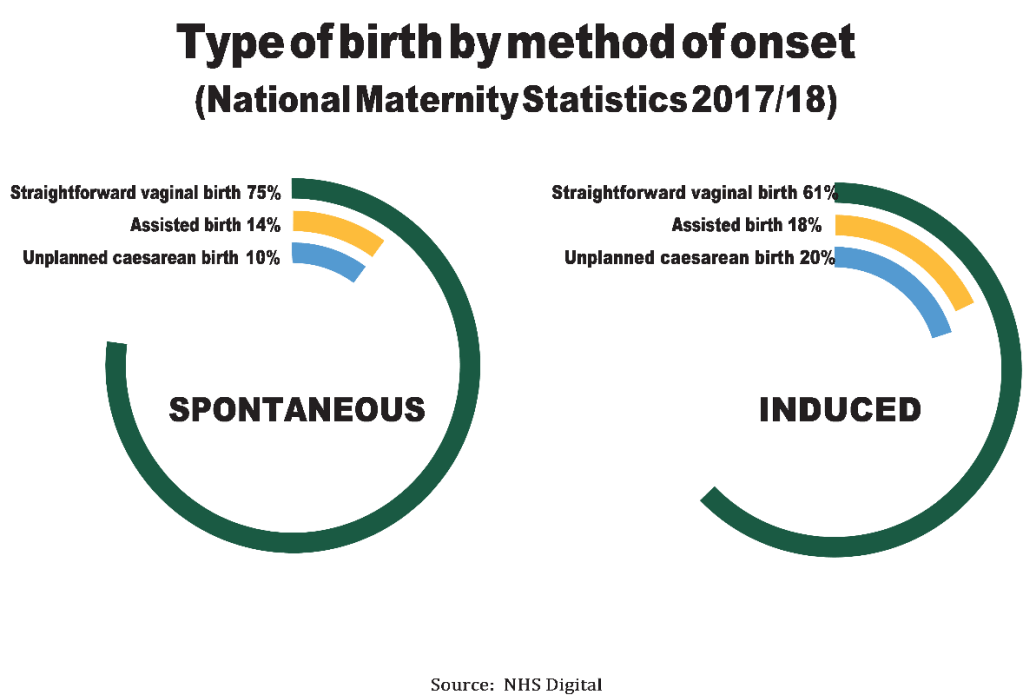
Why might a caesarean be more likely if you’re induced?
Well, if you’re induced, you are likely to be on the labour ward, so there’s all that I’ve mentioned above about the hospital setting. Also, induction increases the risk of distressing your baby, which may be a reason for a caesarean. This increased risk of distress for baby is why induction comes hand in hand with continuous monitoring. What’s wrong with more monitoring? Sounds great! Well, more monitoring means more chance of you needing to stay still/lie down. This makes it more likely that your baby will find the journey difficult (the phrase ‘uphill battle’ springs to mind! Though read the next bit about birth positions!). Monitoring also increases the chance of a panic if your baby’s heart rate is lost or dips (either because baby really is in distress or because the equipment has a blip). It may surprise you to learn that ‘99% of CTG traces which suggest that the baby is stressed and may need to be born more quickly are incorrect’ (Dr Sara Wickham – read her full article on this here). It is probably the case that many caesarean consent forms are signed in a panic by parents after such a beep.
So, is it the induction itself that makes a caesarean more likely? Or is it some of the things that generally come with induction, but that could be managed to a certain extent, that increases the likelihood of complications and the offer of a caesarean? In a nutshell I think it’s probably a bit of both. I have read some incredibly positive induction birth stories, usually where the couples have done a hypnobirthing course or read up a bit on birth and know the potential down-sides of induction and take steps to prevent them!
On my courses, we discuss due dates, induction methods, and many other topics that will help you to feel more knowledgeable and equipped to ask your caregivers the right questions about any offer of care you receive.
3. The best birth position is…
What’s the best position to birth in? Well, the best birthing position is whatever you feel like it is at the time. You know better than any book or hypnobirthing course how your body feels so if you can really tune into your body and follow your instincts then you will get into the right position.

The only reason I talk about birth positions on my course is actually because I think we all have a mental image of some poor woman, lying in bed, legs up in the air, pushing, that we need to ‘unlearn’ and replace with more realistic and helpful images. I do provide a sheet of birth positions that follow the ‘UFO principle’ (Upright, Forwards and Open) because, logically, for most births, this makes sense. But you, your baby and your pelvis are the ultimate experts here. Hypnobirthing can help you to tune into your instincts, block out distractions, and get into a place mentally where you can access this inner knowledge and figure out the best position. If you can do this, you’ll help birth run smoothly, which will ultimately keep the offer of an unnecessary caesarean birth at bay.
So, there are three things to think about if you are at all concerned about having an unnecessary caesarean. The most important thing, in my opinion, is to prepare for your birth. On my hypnobirthing course, we cover decisions about labour in much more detail so that you are knowledgeable and prepared to ask the right questions about any offer of care you receive. But most importantly, I will help you to ensure that you prepare for a variety of different scenarios and types of birth. My courses are not about avoiding caesareans. They are about giving you the tools you need to have a positive birth experience even if the unexpected happens and your birth plan needs to change. Caesarean birth, whether planned or unplanned, can be a wonderfully positive experience for many women.
I have also written a blog called Should I plan for an unplanned C-Section? which talks about why it’s a good idea to be aware of the possibility, and have some ideas of what you might want if this becomes necessary. Or check out my blog How to Plan your Beautiful Caesarean Birth if you think this is how you may need or want to birth your baby.
Follow my Facebook page or Instagram to get updates on blogs, courses and birth tips.
If you’d like to feel prepared and confident about your birth, head over to my courses page and choose the right course for you.
 Pea in the Pod Hypnobirthing